

Mobile vs Stationary Waste Compactors:How to Choose for Transfer Stations
Determine the transfer flow for your project first and then choose between a mobile or stationary waste compactor. This involves determining your design capacity, haul distance, unloading method, reliability requirements, safety requirements and other site constraints. You can organize a project around exchangeable compactor boxes or around a fixed compaction point where waste is loaded into a roll-off waste container and hauled by a hook-lift truck. There is no solution that suits all projects.
Quick Selection Answer
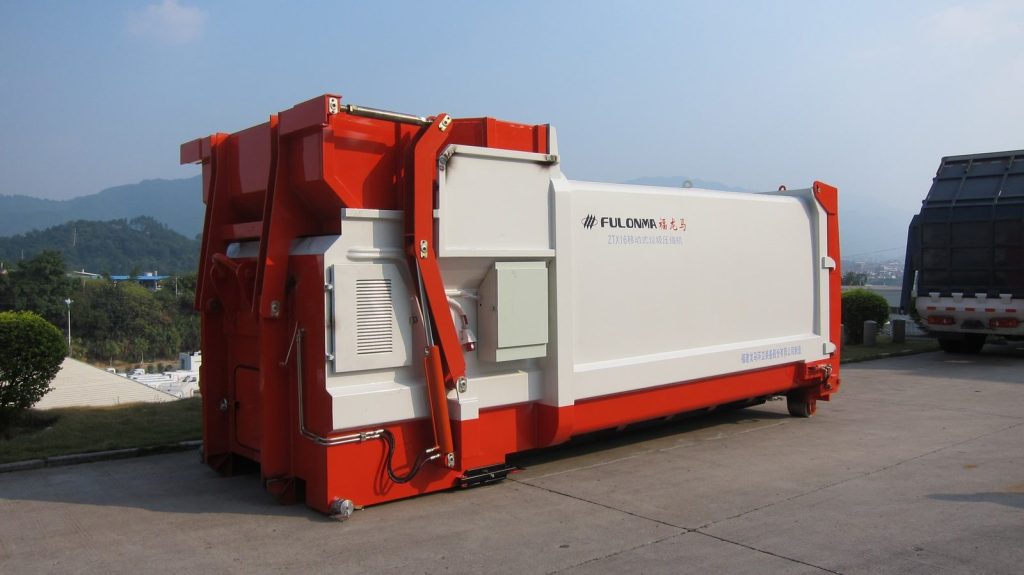
FULONGMA highlights the product level benefits of “one truck, multiple containers” and a “small footprint” for its ZTX16 and ZTX18 movable refuse compactors. Those points describe the product concept; they do not remove the need to verify utilities, permits, civil works, controls, or vehicle compatibility.
A stationary arrangement is worth evaluating when the planned transfer flow is centered on a fixed compaction point. In this structure, a hydraulic ram compacts waste into a roll-off container docked to the compactor. Because the container must resist the compaction force during the loading cycle, it is built with reinforced steel structure. The stationary compactor and its paired roll-off containers. Therefore need to be evaluated as one interface, not as unrelated purchases.
Compare the System and Transfer Flow
The practical difference is where the compaction function sits in the transport sequence.
In a stationary compactor setup, the compactor is fixed at the transfer point and pushes waste into a paired roll-off container. The workflow follows these steps: an empty container is positioned at the compactor, docked and locked into place, filled with compressed waste, then picked up by a hook-lift truck and transported to the disposal site for unloading.
With the FULONGMA ZTX16 and ZTX18 movable concept, the published positioning is based on one vehicle serving multiple boxes. The rotation plan must therefore define how many boxes are required, where each will stand, when a vehicle will exchange it, and which interface will be used. Container volume alone cannot settle these project inputs.
Use Six Inputs to Make the Decision
The major selection factors for a transfer-container or vehicle-loading arrangement include design capacity, distance to the disposal site, cost, reliability, safety, and the unloading method at the disposal site. Turn those factors into a comparison sheet for both concepts.
1 Define design capacity
Record the required receiving capacity and the expected operating window. Keep this as a project requirement until the supplier confirms a configuration. Do not convert a published container volume into an assumed daily throughput.
2 Map the haul distance
State the distance from the transfer point to the destination and record the intended transport schedule. Use both to test the planned rotation of movable compactor containers or roll-off containers.
3 Compare cost on the same boundary
Identify what is included in each of the proposals. Equipment, transport units, site preparation, utilities, controls and commissioning and who is responsible for operating the system. List separately to ensure like items are compared and unlike items are not.
4 Define the reliability requirement
Write down the if the compaction point, hook-lift truck, movable compactor container, or stationary roll-off container becomes unavailable. Make each supplier come up with the operation reaction, maintenance accessibility and parts plan in relation to the design provided.
5 Document safety responsibilities
Determine who is in charge of the loading area, vehicle movements, connecting stage, compaction process, and unloading phase. The local safety regulations and the final operation procedures should be confirmed by the project management party.
6 Confirm the unloading method
Explain how the destination receives and offloads the waste that is shipped. This item should be part of the RFQ as it affects the whole shipment process and not just the compactor.
Check the Site Utility and Vehicle Interfaces
Before approving a concept, confirm proposed equipment position, proposed access path, proposed turning/exchange area, proposed civil-work requirements, proposed locations for utilities etc, proposed drainage, local permit requirements, proposed operating procedure and proposed maintenance access etc to confirm against site specific requirements as opposed to general rule.
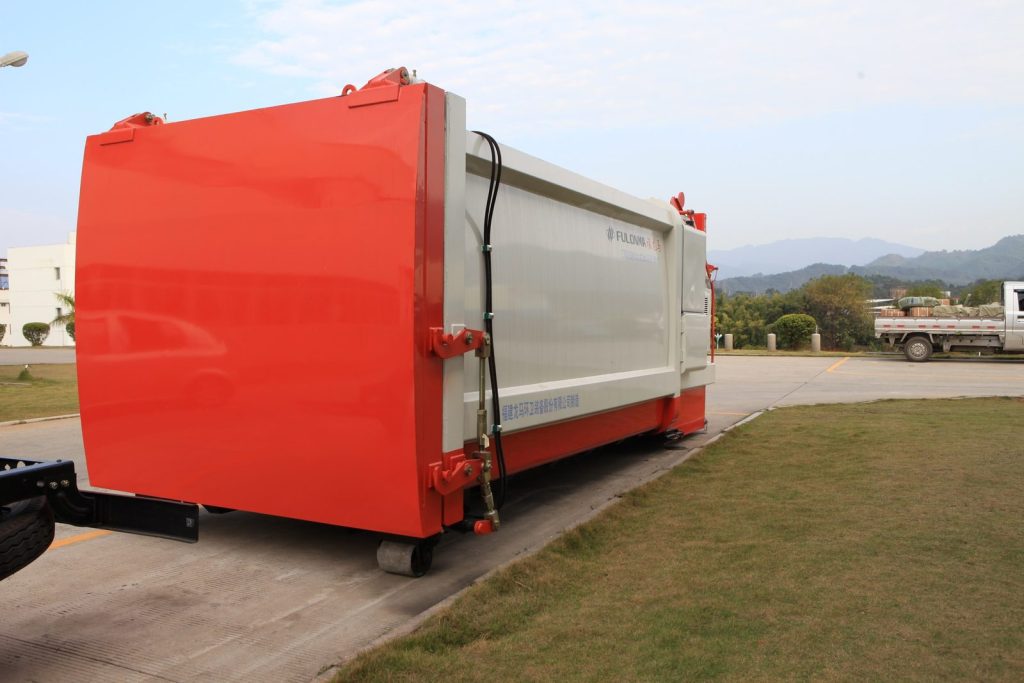
For a mobile solution, describe the transport vehicle, hook-lift or other handling interfaces, the container dimensions and how they connect, and the compatibility of the unloading end. For a stationary solution, define compactor-to-container docking interface and the container’s structural ability to resist the compaction forces. Drawings and confirmation of interface details should be requested and confirmed prior to treating either solution as complete.
How ZTX16 and ZTX18 Fit a Rotating Container Plan
FULONGMA provides two movable refuse compactor options for comparison. The ZTX16 comes with a 16 m³ container volume and the ZTX18 has an 18 m³ container volume. Both models adopt a 1.3 m³ compression chamber, deliver a 3:1 compression ratio, and achieve a compression cycle time of no more than 35 seconds.
Use them as the starting point for a supplier discussion. Then provide the waste stream, required capacity, operating window, haul distance, site layout, unloading method, and vehicle interface so the offered model can be checked against the whole system.
You can also review FULONGMA’s broader garbage transfer equipment range when mapping the collection and transfer chain.
RFQ Checklist for a Comparable Proposal
Send the same core information to every bidder:
- Required design capacity and operating window
- Waste stream and any handling restrictions
- Distance to the disposal or processing destination
- Site plan and intended equipment position
- Available utilities and project-specific civil requirements
- Proposed transport vehicle and handling interface
- Required unloading method at the destination
- Safety roles and operating controls
- Reliability, maintenance access, and service expectations
- Items that must be included or excluded from the quoted scope
Ask the supplier to return a marked interface list with the proposal.
Frequently Asked Questions
Q What is the main difference between a mobile and stationary waste compactor
A: A stationary compactor stays at the transfer point and uses a hydraulic ram to push waste into a compatible transfer trailer. The mobile concept discussed here organizes the flow around movable compactor boxes. FULONGMA’s ZTX16 and ZTX18 product describe one vehicle serving multiple boxes.
Q Is a mobile compactor always better for a small site
A: No universal choice follows from site size alone. The FULONGMA lists a small footprint as a characteristic, but the project must still verify access, exchange space, utilities, civil works, permits, controls, and vehicle compatibility before selecting the system.
Q Which factors should be compared before choosing
A: Compare the design capability, the distance to the location where the material will be disposed, cost, reliability, safety, and the unloading process. Also compare the site considerations, utility considerations, civil works considerations, permits required, control considerations, and vehicle interface considerations that are specific to each project.
Q What are the published differences between ZTX16 and ZTX18
A: The ZTX16 is equipped with a 16 m³ container volume, and the ZTX18 features an 18 m³ container volume. Both models come with a 1.3 m³ compression chamber, a 3:1 compression ratio, and a compression cycle time of no more than 35 seconds.
Discuss Your Transfer Station Requirements with FULONGMA
If a rotating-container approach may fit your project, send FULONGMA the operating inputs instead of requesting a model by volume alone. Contact FULONGMA to begin the technical discussion.