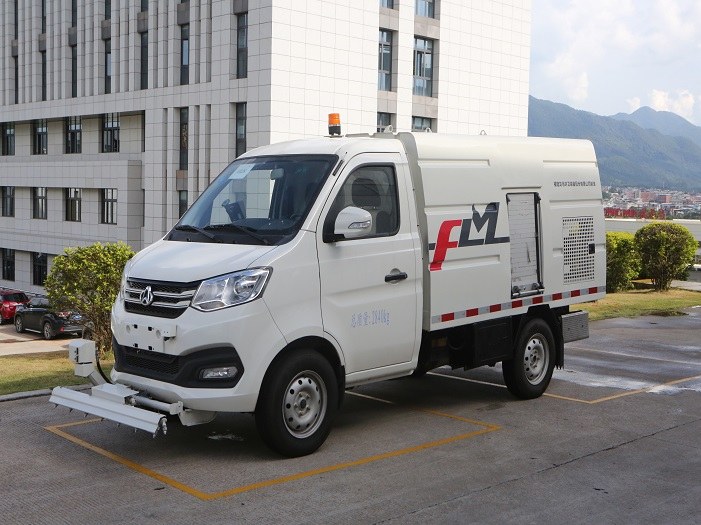
A road maintenance truck removes stubborn pavement contamination by combining concentrated water pressure with tools designed for both broad washing and precise spot cleaning. Unlike a conventional sweeper, it can loosen oil residue, wash narrow sidewalks, clean curb edges, and reach surfaces around public facilities. For urban teams, the practical advantage is controlled cleaning in places where a full-size washing vehicle is too wide or a mechanical brush cannot remove material bonded to the surface. FULONGMA’s road maintenance truck, such as the FLM5030TYHCC6, adopts this approach through a compact design featuring a 15 MPa high-pressure water pump, a 1.8 m cleaning width, and a 1.3 m³ water tank. These specifications make it well suited for pedestrian walkways, non-motorized lanes, market areas, and other locations that require more targeted cleaning than routine sweeping can provide.
Why Urban Pavements Need Targeted High-Pressure Cleaning
Municipal pavements collect more than loose leaves and dust. Cooking grease near food streets, tire residue, tracked soil, drink spills, and adhesive remnants from unauthorized posters can bond to concrete, stone, or asphalt. A broom may move loose debris while leaving the visual stain and slippery film behind.
High-pressure washing applies energy directly at the surface, helping dislodge contamination from pores and joints. The result depends on the pavement material, the age of the stain, nozzle distance, water pressure, and whether an approved cleaning agent is needed. Operators should therefore treat pressure as a controllable tool rather than assume maximum pressure is suitable for every surface.
Where Routine Sweeping Falls Short
Street sweepers are efficient when the task is to collect widespread loose material. They are less effective at cleaning wall bases, bollard surrounds, recessed curb lines, and compact spaces between fixed street furniture. In these areas, a targeted jet or handheld tool can work closer to the contamination without requiring a large vehicle to occupy the full road.
How a Road Maintenance Truck Works
The cleaning process begins with water storage, filtration, and delivery to a high-pressure pump. The pump supplies the front cleaning assembly or a more focused device, depending on the task. The operator can make a controlled forward pass for general pavement washing, then use a single-point or handheld system for corners and stubborn deposits.
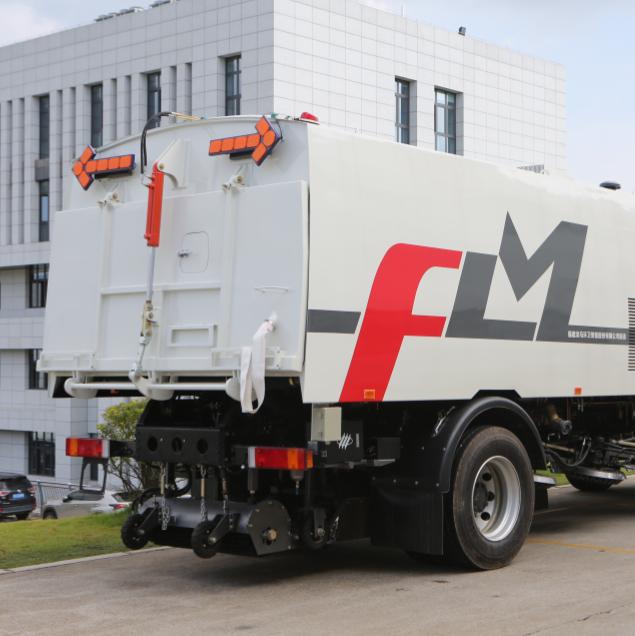
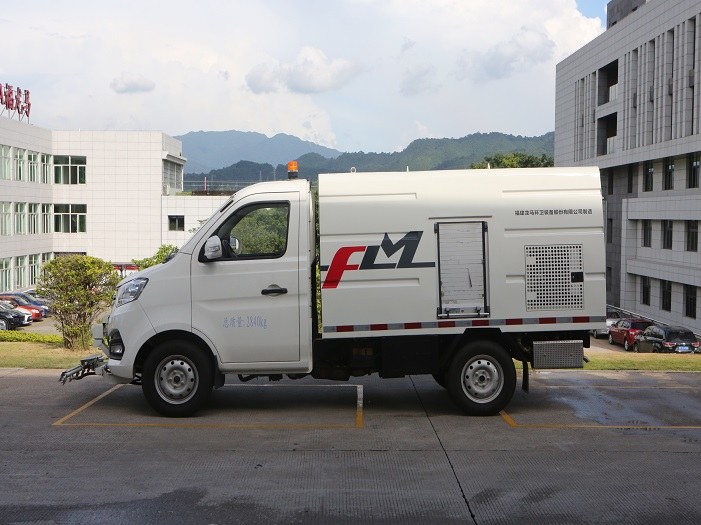
The FLM5030TYHCC6 road maintenance truck product configuration places the high-pressure pump and its auxiliary gasoline engine behind the water tank. This layout gives maintenance personnel direct access to the main working components and separates the cleaning power source from normal vehicle movement.
High-Pressure Pump and Front Cleaning System
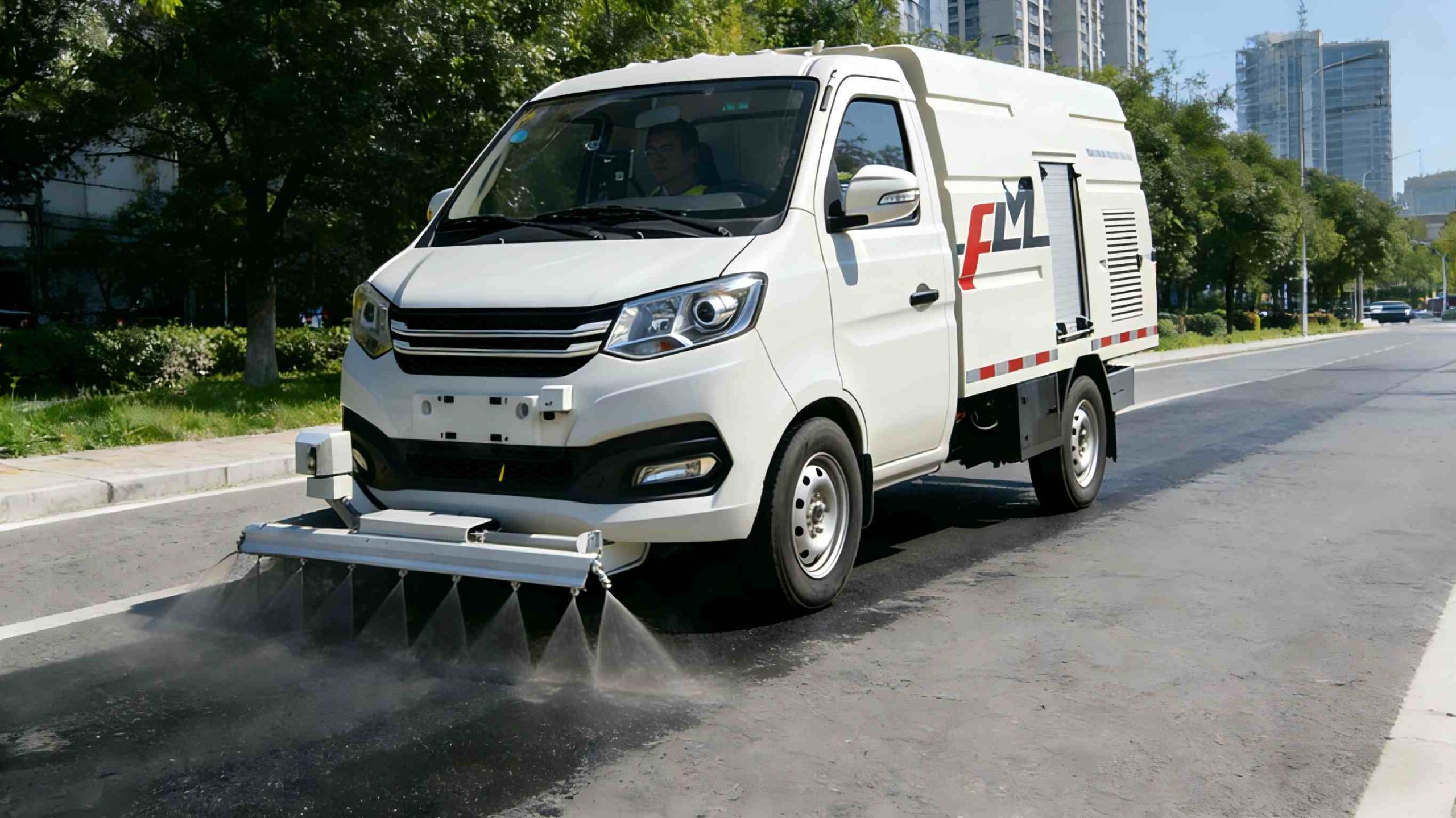
For the FLM5030TYHCC6, the listed pump pressure is 15 MPa and the cleaning width is 1.8 m. It features ±20° horizontal swing and ±12° vertical rotation, actuated by electric push rods. The width supports an efficient pass along sidewalks and non-motorized lanes, while the pressure helps break the bond between the pavement and persistent surface deposits. A listed pump flow of 38 L/min provides useful context for balancing cleaning intensity with onboard water capacity.
A front spray assembly distributes water across a defined strip rather than relying on a single narrow jet. This is suitable for uniform washing after loose debris has been removed. For delicate paving, joints, painted markings, or damaged surfaces, operators should adjust their technique and follow the surface-maintenance requirements instead of holding a concentrated jet too close.
Single-Point and Handheld Cleaning
Broad coverage does not solve every cleaning problem. A column-style single-point device delivers a cleaning flow of 30 L/min, with electrically controlled full direction swing (up, down, left and right). It can direct pressure toward localized sanitary corners, while a handheld spray gun or push-type nozzle extends access along walls, curbs, steps, and spaces around fixed objects. This combination allows one vehicle to shift between route cleaning and detail work.
That flexibility is particularly useful around transit entrances, public squares, market lanes, waste-bin stations, and pedestrian facilities. The vehicle remains the water and power platform, while the accessory determines how precisely the cleaning force is applied.
Choosing the Right Cleaning Mode for the Surface
Oil-Stained Pavements and Market Areas
Oil contamination often needs a staged response: remove loose material, contain the work area, test a small section, and then apply controlled pressure. Fresh residue and deeply absorbed stains will not behave the same way. Where detergents are permitted, they must be compatible with the pavement and local wastewater rules.
A road maintenance truck supports this work by bringing water, pressure, and multiple application tools to the site. It does not eliminate the need for surface assessment or runoff control, but it gives operators a more precise platform than broad low-pressure rinsing.
Sidewalks, Curbs, and Public Facilities
Narrow sidewalks require attention to vehicle width, turning space, visibility, and nearby street furniture. Front washing is appropriate on open stretches, whereas handheld cleaning is better around curb returns, utility covers, walls, benches, and bin enclosures. Work zones should remain separated from pedestrian movement until overspray and slip risks are controlled.
Where Are Road Maintenance Trucks Used
FULONGMA positions the FLM5030TYHCC6 as a pavement-focused cleaning vehicle for oil-stained roads, urban sidewalks, non-motorized lanes, wall surfaces, and public facilities. Its combination of a compact platform, high-pressure pump, broad front cleaning, and detail-cleaning tools makes it most relevant where access and contamination type matter as much as total water volume.
For equipment selection, users should confirm the working surface, route width, expected refill cycle, attachment needs, and local discharge requirements. Optional functions should be evaluated against actual tasks rather than added by default. This keeps the vehicle configuration aligned with daily cleaning work.
Conclusion
A road maintenance truck adds precision to urban cleaning by addressing contamination that sweeping and low-pressure rinsing can leave behind. When water pressure, nozzle choice, access, and runoff management are matched to the route, the vehicle can improve the care of sidewalks, market areas, non-motorized lanes, curb edges, and public facilities.
The value of the FLM5030TYHCC6 lies in combining broad pavement washing with targeted tools on one compact platform.
Explore FULONGMA solutions for focused urban pavement care.
FAQ
Q: What is a road maintenance truck used for?
A: The road maintenance truck is designed specifically for the task of washing sidewalks, non-motorized pathways, oil spills on roads, curbside areas, wall bases, and any other surfaces of public facilities. The road maintenance truck utilizes a built-in water source coupled with high-pressure devices and attachments that enable washing of large road surfaces as well as specific areas.
Q: How is a road maintenance truck different from a street sweeper?
A: A street sweeper primarily collects widespread loose debris with brushes and suction. A road maintenance truck focuses on bonded contamination by applying high-pressure water through a front cleaning assembly, single-point device, or handheld tool. The two machines are complementary: one handles collection, while the other provides targeted surface washing.
Q: What specifications matter when choosing a pavement maintenance truck?
A: Important factors include pump pressure and flow, cleaning width, water-tank capacity, route access, operating duration, available attachments, refill locations, and surface sensitivity. Operators should also consider drainage controls and maintenance access. The best configuration is the one matched to actual contamination and route conditions, not simply the highest pressure.